Emergency Preparedness Merit Badge: Complete Guide for Scouts and Parents
Key Takeaways
- The emergency preparedness merit badge is one of the 14 Eagle-required merit badges in Scouting America. Scouts must earn either Emergency Preparedness or the Lifesaving merit badge. Requirements were last updated effective January 1, 2023.
- Scouts learn the five aspects of emergency preparedness-prevention, protection, mitigation, response, and recovery-and must complete family, troop, and community emergency plans covering real-world scenarios.
- Requirements include understanding the National Incident Management System (NIMS), the Incident Command System (ICS), assembling a personal emergency service pack, and participating in at least one emergency service project.
- Small Space Emergency focuses on helping Scouts and families build compact, apartment-friendly emergency kits, go-bags, and mobilization plans that work even in studios, dorms, and micro-apartments.
- This article is a visual, listicle-style guide with 10 high-quality, photorealistic, HDR images illustrating real-world emergency preparedness in small spaces.
Introduction: What Is the Emergency Preparedness Merit Badge?
The Emergency Preparedness merit badge teaches Scouts how to plan for, respond to, and recover from emergencies at home, in the community, and in the outdoors. It is one of the most comprehensive badges in the Scouting program, covering everything from kitchen fires to large-scale disasters. Emergency preparedness equips individuals to protect themselves and others during crises, and the badge helps Scouts develop confidence and leadership skills in emergency situations.
Either Emergency Preparedness or Lifesaving is required for the Eagle Scout rank. The requirements were last revised effective January 1, 2023, with minor updates rolling in through January 2025. The official pamphlet is Publication Number 35888, and the current preparedness merit badge pamphlet or one approved by your counselor should always be used for exact requirement wording.
This guide is written from the perspective of Small Space Emergency, focusing on how Scouts in apartments, dorms, or small homes can meet every requirement without needing a sprawling garage or finished basement. Counselors must approve all work, plans, and activities. This article is a study and planning aid-not an official replacement for requirements approved by your counselor.
Photo 1: Small-Space Emergency Prep Scout Setup
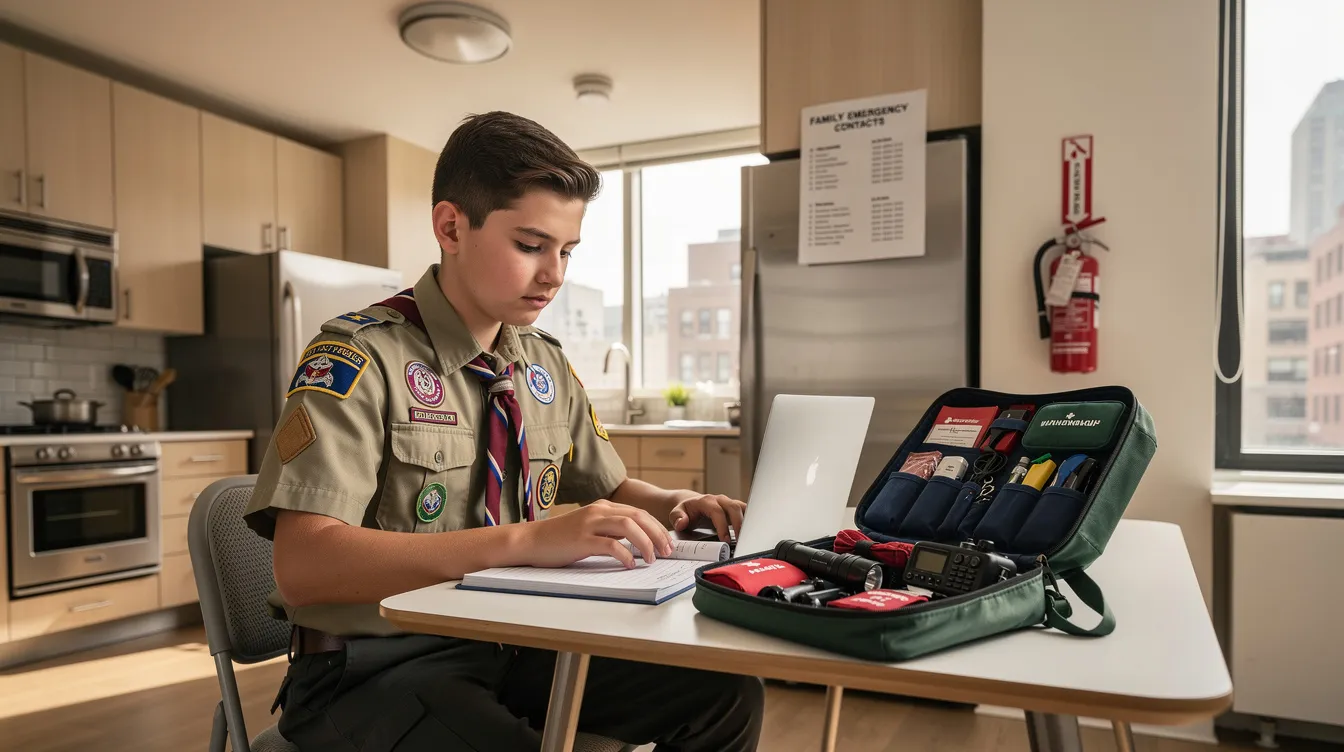
Planning for emergencies in a small city apartment.
Emergency Preparedness Merit Badge Requirements Overview
The badge covers a wide arc: understanding emergency situations, planning for family emergencies, home safety inspections, response to dangerous situations, signaling for help, moving an injured person, the National Incident Management System, emergency service participation, and career exploration. The Emergency Preparedness merit badge teaches disaster risk management principles that apply whether you live in a rural farmhouse or a tenth-floor studio.
Current requirements (updated 2023) are organized into these major themes:
- Emergency situations - identifying, analyzing, and discussing at least 10 scenarios
- Family and community emergency plans - creating written plans and assembling kits
- Prevention and safety inspections - home safety checklists, floor plans, hazard analysis
- Response skills - rescues, signaling, transporting injured people
- National systems - NIMS and the local incident command system
- Emergency service participation - drills, projects, and mobilization planning
- Careers - exploring professional paths in emergency services
Download a current fillable workbook to track your answers, but always use it alongside the official pamphlet or one approved by your counselor. We will not reproduce requirement text verbatim here. Instead, we will explain what each part really asks Scouts to do, with tips tailored to small-space living. Confirm requirement numbering with your merit badge counselor, because wording and details can change when BSA updates Pamphlet 35888 or the digital requirements.
Prerequisite: First Aid Merit Badge and Core Skills
Earning the first aid merit badge is required before or while working on Emergency Preparedness. Many counselors expect the aid merit badge completed first because it builds foundational skills that directly feed into the more complex emergency preparedness requirements. It requires earning the First Aid merit badge as a prerequisite for good reason.
Scouts should be comfortable with:
- CPR basics and AED use
- Controlling bleeding and applying pressure bandages
- Treating shock and positioning patients
- Managing burns, fractures, and common illnesses
Many troops schedule First Aid in spring and Emergency Preparedness in late summer or fall so Scouts can build directly on what they just learned. This timeline works especially well for families who want to coordinate a family meeting and home inspection during the planning phase.
For families in small spaces, store first aid supplies in a clearly labeled, compact wall-mounted cabinet or under-sink container near the kitchen for quick access. A shoebox-sized kit is enough for most apartments. First aid skills will be used directly in requirements covering dangerous situations, moving an injured person, and participating in an emergency service project.
Aspects of Emergency Preparedness: The Big Picture
FEMA established five aspects of emergency preparedness that form the backbone of this badge: prevention, protection, mitigation, response, and recovery. Scouts must define each one and give concrete examples. Understanding prevention, protection, mitigation, response, and recovery is the lens through which every emergency scenario in the badge is analyzed.
Here is what each aspect means:
| Aspect | Definition | Small-Apartment Example |
| Prevention | Actions to stop emergencies before they occur | Keep stove area free of towels and grease buildup |
| Protection | Safeguarding people and property during emergencies | Install a compact fire extinguisher within arm's reach of the stove |
| Mitigation | Reducing the severity or impact of an emergency | Close interior doors to slow fire spread in a hallway |
| Response | Acting during an emergency | Call 911, evacuate using practiced escape routes |
| Recovery | Returning to normal after the event | Contact landlord, file insurance claim, ventilate and clean |
Prevention aims to stop emergencies before they occur. Protection involves actions to reduce damage during emergencies. Mitigation focuses on lessening the impact of emergencies. Recovery aims to restore normalcy after an emergency. Emergency preparedness helps reduce the impact of disasters when all five aspects work together.
Counselors often start by asking Scouts to walk through these five aspects for each scenario on their emergency chart. If you live in an urban high-rise, think about city-specific risks like power grid failures, elevator malfunctions, and water shutoffs-not just wilderness incidents. FEMA established the five aspects of emergency preparedness precisely because they apply to every environment, from a cabin in the woods to a studio apartment downtown.
Photo 2: Visualizing the Five Aspects
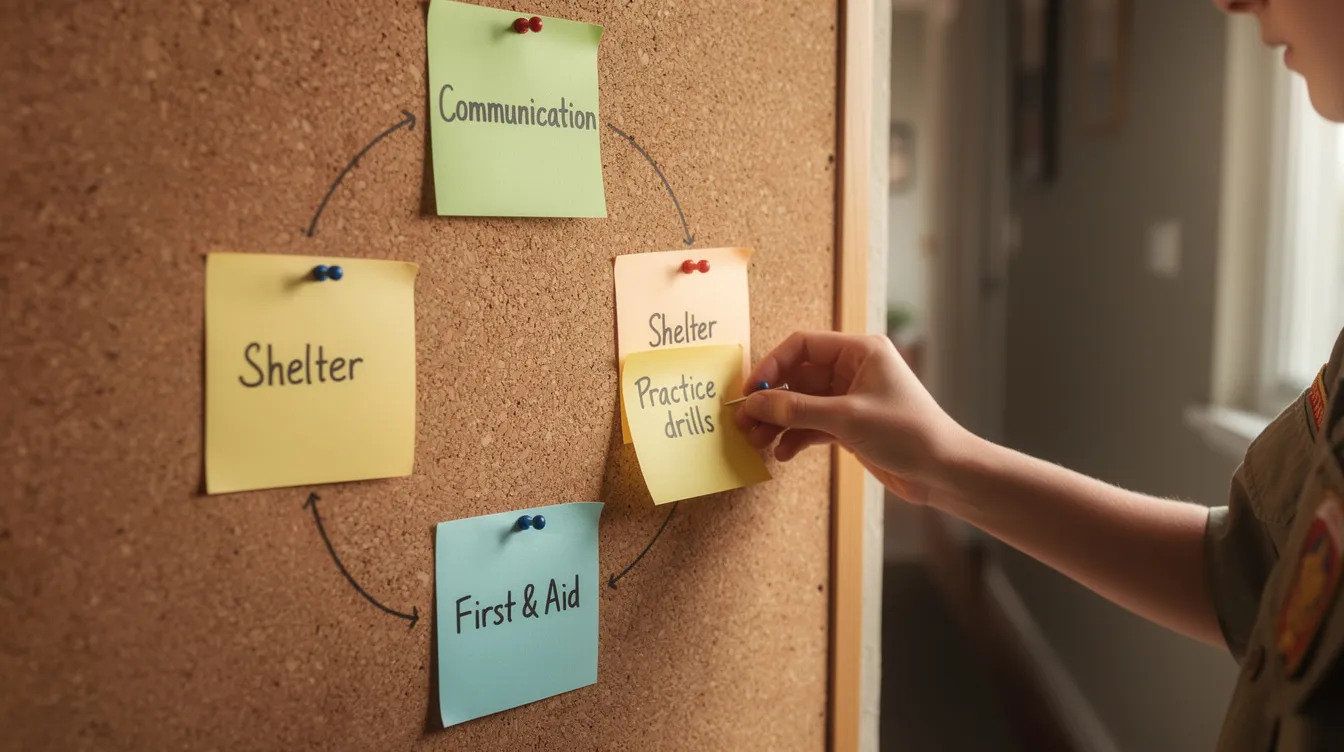
Color-coded cards break down the five aspects of emergency preparedness at a glance.
Requirement Focus: Understanding Emergency Situations
Early requirements ask Scouts to discuss several types of emergency situations with their counselor and analyze them using a chart or method approved by the counselor. Emergency situations include household hazards like gas leaks, fires, and severe weather, as well as larger-scale events.
Scouts should choose at least 10 distinct scenarios from the list provided in the requirements, which typically includes:
- Stovetop or flammable liquid fire
- Gas leak in a home or building
- Food poisoning
- A flash flood or major flooding
- Nuclear power plant emergency
- Automobile crash or vehicle stalled in a remote area
- Earthquake, tornado, or hurricane
- Hazardous materials spill
- A capsized or disabled motorboat
- A vehicle trapped in a storm
For each scenario, describe likely causes, warning signs, and what to do first, always emphasizing safety precautions and when to call 911. Pay attention to which emergencies are most realistic where you live. A Scout in a Chicago high-rise should focus heavily on fire, blackout, and gas leak scenarios, while a Scout in Southern California should prioritize earthquake and wildfire readiness.
Write answers clearly in the workbook and practice explaining them out loud before the counselor meeting. Most counselors will expect you to connect each emergency back to the aspects of emergency preparedness covered earlier. In 2023 alone, there were approximately 23,700 residential electrical malfunction fires in the United States, causing roughly 305 deaths and 800 injuries-proof that household emergencies are not abstract exercises.
Planning for Family Emergencies and Small-Space Emergency Plans
A core requirement asks Scouts to create family emergency plans for specific emergencies, and the counselor must review and approve them. Scouts learn to develop family emergency plans and assemble emergency kits as part of this process. Discuss potential emergencies during family meetings for preparedness-the badge literally requires holding a family meeting to review your plans.
Your family emergency plans should include:
- Communication methods - primary phone numbers, an out-of-town emergency contact, and what to do if phone service is down
- Meeting places - one just outside your building and one outside your neighborhood
- Responsibilities - who grabs the kit, who checks on pets, who calls the contact
- Shelter-in-place and evacuation strategies - emergency plans should include sheltering in place and evacuation strategies for different scenarios
For small homes and apartments, designate a nearby street corner, park, or public library as the outside meeting point. Families should create a fire escape plan with two routes, and your family's home escape plan should be drawn on a simple floor plan showing every exit. Emergency plans should include a safe meeting place outside the home that every family member knows by heart.
Tape a one-page emergency contact sheet inside a cabinet door, with backup copies saved digitally. Families should practice their emergency escape plans regularly-at least twice a year. Small Space Emergency offers apartment-sized checklists Scouts can use as a starting point, as long as every plan is still reviewed and approved by your counselor.
Photo 3: Family Emergency Plan in a Small Apartment
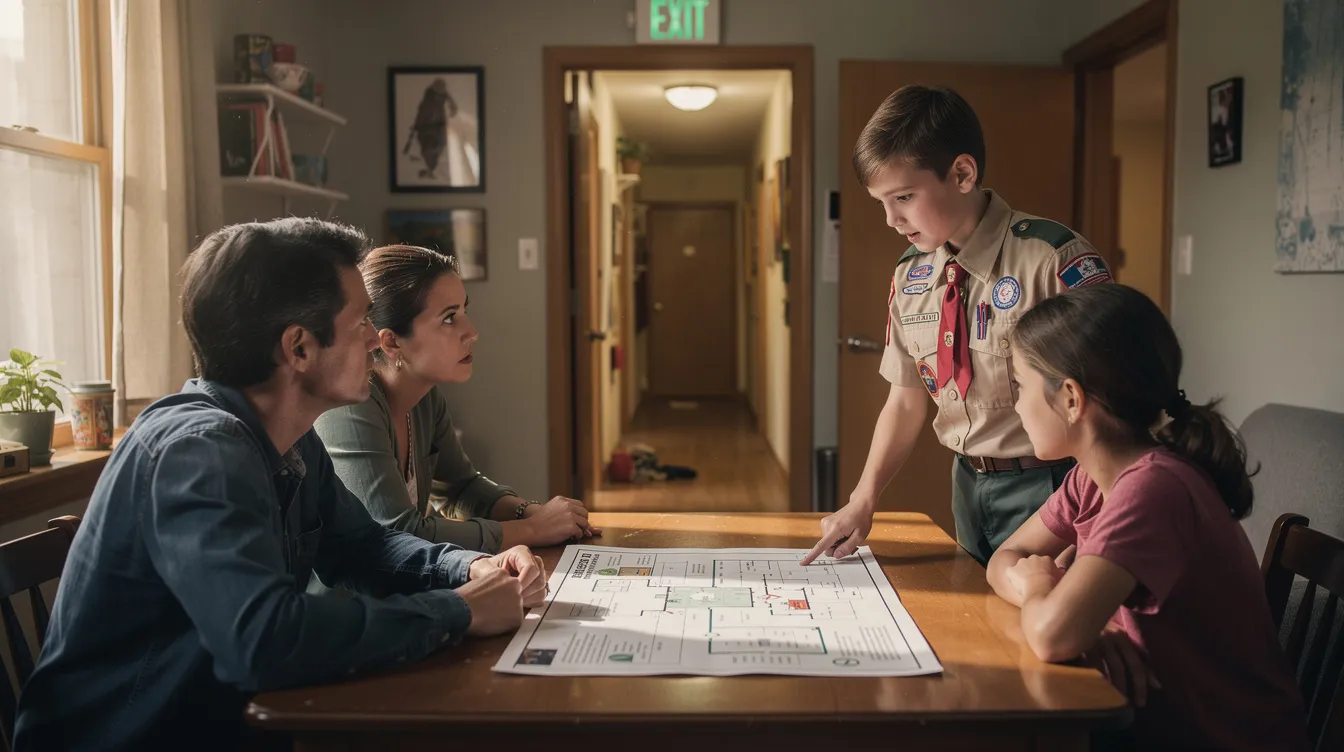
A Scout leads a family meeting to finalize evacuation routes and emergency contacts.
Home Safety Inspections, Floor Plan, and Prevention Activities
A requirement asks Scouts to inspect a home using a home safety checklist included in the preparedness merit badge pamphlet or one approved by your counselor. Use a home safety checklist to inspect for hazards, covering everything from frayed electrical cords to blocked exits. Inspect a home for safety hazards with an adult-this is not a solo activity.
Scouts must also draw a simple floor plan of their home or apartment. Mark:
- All exits and escape routes (at least two ways out)
- Smoke detectors and carbon monoxide detectors
- Fire extinguisher locations
- Gas shutoffs and electrical panels
- Safe meeting points outside the building
Small-space tips matter here. Check that hallways to exits are not blocked by storage bins or shoes. Ensure a fire extinguisher is accessible even in a tiny kitchen. If you sleep in a loft bed or basement room, identify two ways out. After completing the inspection, present your completed safety checklist and findings with your counselor.
Scouts must also develop emergency prevention plans for at least five family activities outside the home-such as a camping trip, a sporting event, a worship service, travel, or a community event. Each plan must include hazard analysis covering possible hazards and the full sequence of prevention, protection, mitigation, response, and recovery, all approved by your counselor.
Annotated floor plans with photos make your workbook presentation dramatically clearer during counselor conferences.
Photo 4: Annotated Floor Plan on a Small Desk
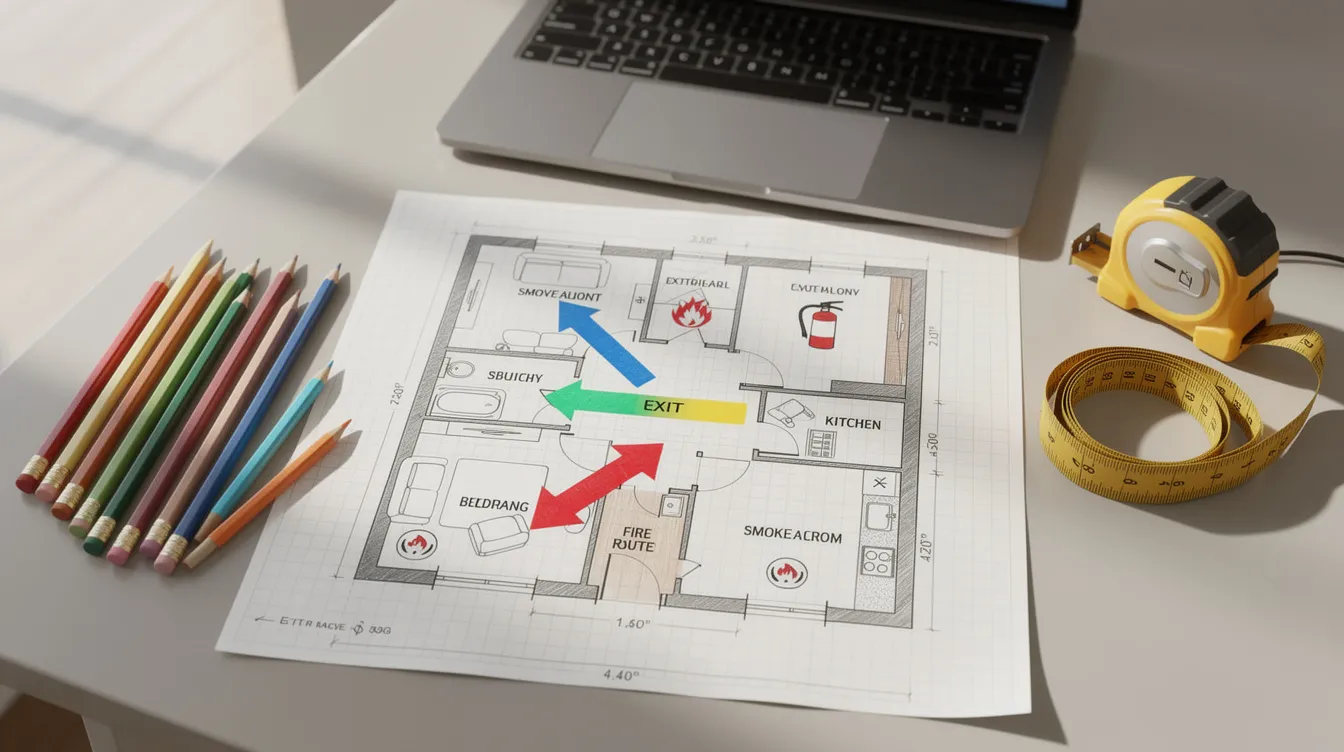
A clear, annotated floor plan marks escape routes and safety equipment in a studio apartment.
Personal Emergency Service Pack and Household Go-Kits
Several requirements refer to assembling a personal emergency service pack for mobilization calls and a family disaster kit for home use. These are two distinct items. Your family disaster kit should sustain a family for two weeks-that is the standard recommended by emergency management professionals. Emergency supply kits should sustain a family for two weeks, covering both sheltering in place and evacuation needs. An evacuation kit should be portable and ready to grab at a moment's notice.
For a Scout's personal emergency service pack appropriate for a mobilization call, focus on weight and portability:
- High-visibility vest or reflective band
- Compact LED flashlight with extra batteries
- Whistle on a lanyard
- Small first aid pouch
- Notepad and pen
- N95 masks (2–3)
- Collapsible water bottle
- Snack bars (rotate every 6 months)
- Small power bank and charging cable
- Printed mobilization plan card with emergency contacts
Store family go-kits under beds, on closet shelves, or in modular bins that double as furniture-especially practical in studios or micro-apartments. Kits must include essentials for sheltering-in-place and evacuation. Emergency supply kits should be inspected regularly for updates; batteries, medications, and food should be rotated at least twice per year. Any pack used to meet requirements should be reviewed and approved by your counselor.
Photo 5: Compact Personal Emergency Service Pack Layout
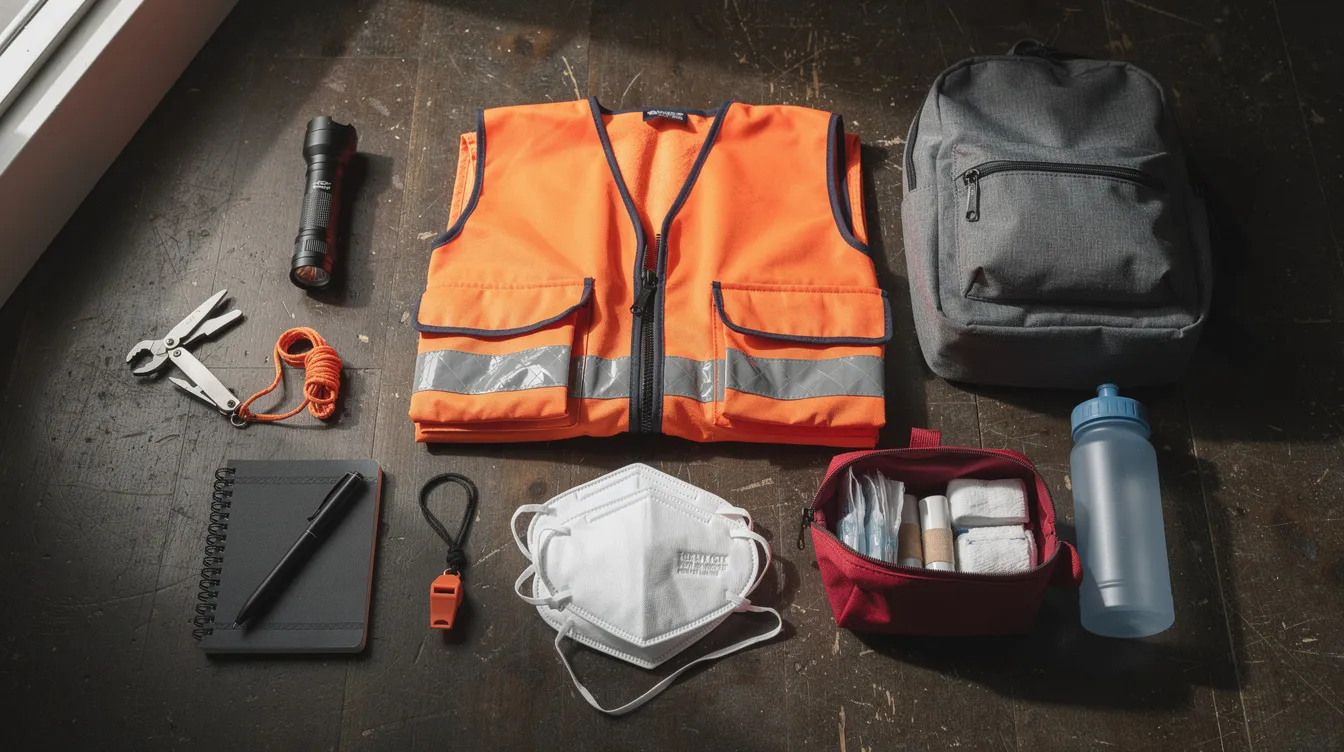
Everything a Scout needs for a mobilization call, sized to fit behind a closet door.
Dangerous Situations: Rescues Without Becoming a Victim
Requirements ask Scouts to demonstrate how to safely assist someone in dangerous situations without putting themselves in danger. Scouts practice safe rescue techniques for various dangerous scenarios, always starting with scene assessment.
Key scenarios and what to do:
- Live household electric wire - Never touch the person or wire. Turn off electricity at the circuit breaker during electrocution if you can safely reach it. Use a dry, non-conductive object (wooden broom handle) to push the wire away. Immediately call 911 after rescuing someone from electrical shock.
- A structure filled with carbon monoxide - Carbon monoxide is colorless and odorless, causing serious health issues. Do not enter the structure. Call 911 and get everyone outside into fresh air immediately.
- Clothing on fire - Instruct a person on fire to stop, drop, and roll. Smother flames with a blanket if available.
- Drowning victim - Use a long object to reach someone drowning without entering water. Throw a rope, extend a pole, or toss a flotation device. Never jump in unless you are trained and the risk is manageable.
- Vehicle trapped in rising water - Direct the person to exit immediately if water is still low enough. Call emergency services.
Knowing when not to attempt a direct rescue is just as important as knowing how. If the scene is unsafe, your job is to call trained responders.
Scouts should tie their rescue methods back to the prevention, protection, mitigation, response, and recovery framework whenever describing what they would do. Counselors should emphasize that the incident command system chain of command applies when part of an organized response.
Photo 6: Practicing Rescue Techniques in a Hallway
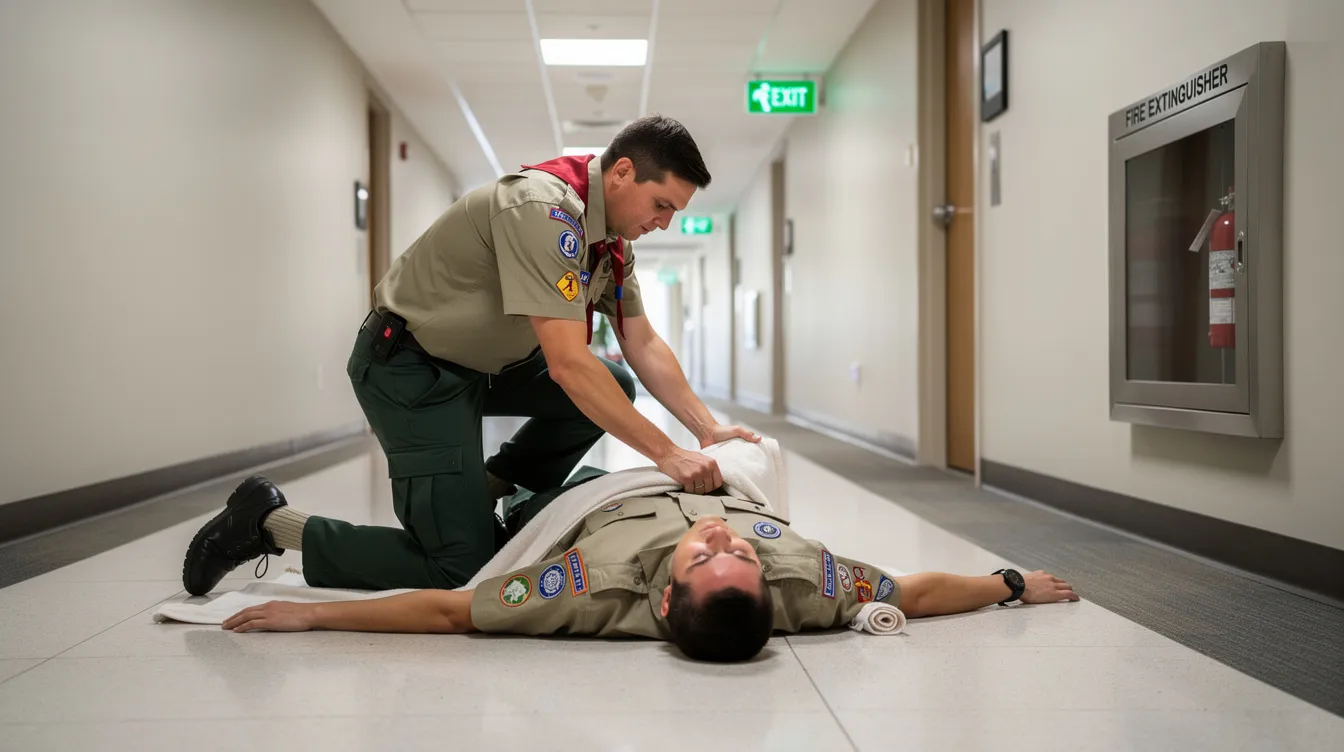
Practicing safe drag techniques in a real apartment hallway reinforces proper body mechanics.
Signaling for Help and Moving an Injured Person
Separate requirements address signaling for help and methods for moving an injured person when absolutely necessary. For signaling, Scouts must demonstrate audible, visual, and electronic methods to alert rescue aircraft, ground searchers, or water-based rescue teams.
Practical signaling methods for small-space Scouts:
- Whistle - Three short blasts is the universal distress signal. Effective from balconies and stairwells.
- Flashlight - Use deliberate, spaced pulses from a window at night. SOS is three short, three long, three short flashes.
- Cell phone - Learn your phone's built-in SOS feature. Always provide clear location details when contacting 911.
For moving an injured person, Scouts must demonstrate at least two improvised carries or drag methods with at least one other person. Options include:
- Two-person seat carry - Interlocked wrists create a seat under the patient's thighs
- Blanket drag - Roll the person onto a blanket and drag from the head end, protecting the spine
Emphasize spinal precautions and when not to move someone-if a back or neck injury is suspected, moving can cause permanent damage. Practice in your living room with furniture pushed back to create safe lanes. Document which techniques you practiced, with whom, and where, and get counselor feedback on form and situational judgment. Scouts learn to effectively communicate during emergencies and draw up action plans for every scenario.
Photo 7: Small-Space Signaling and Movement Practice
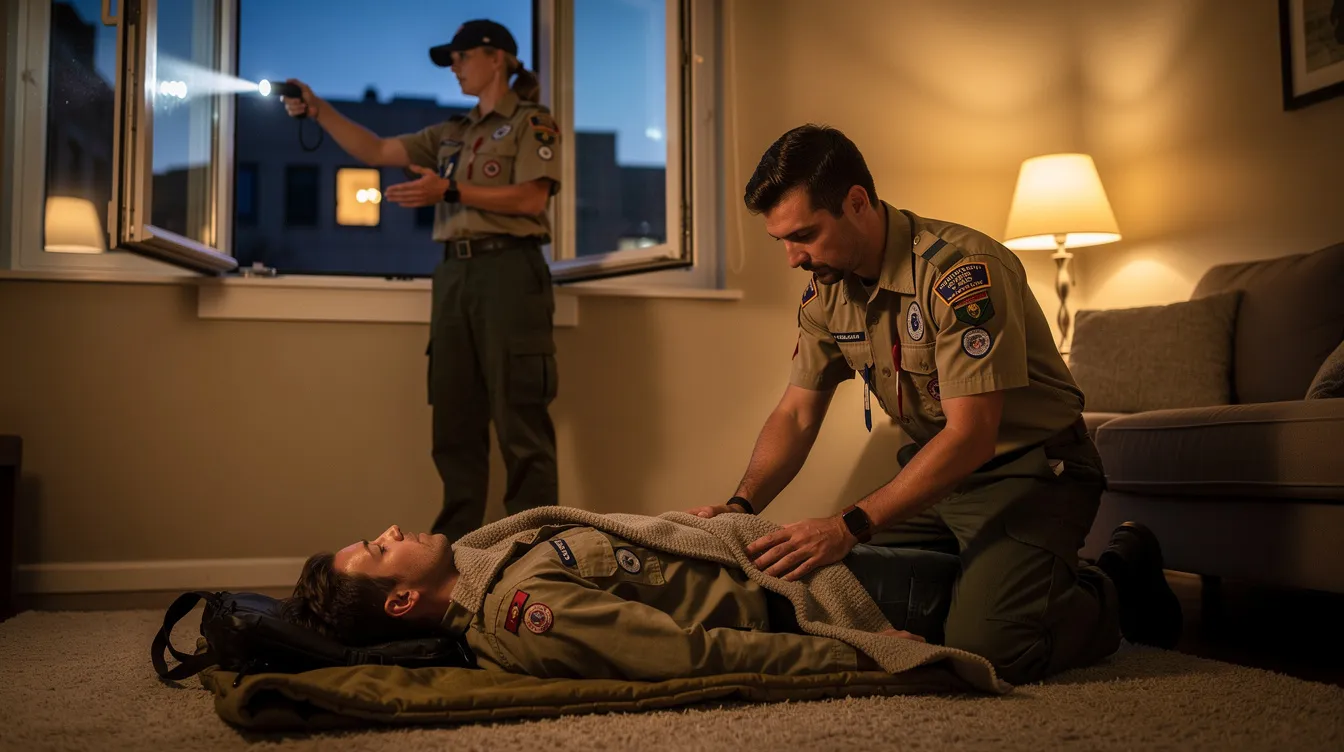
Practicing signaling from a window and blanket drags in a cleared living room.
National Incident Management System (NIMS) and Incident Command System (ICS)
Requirements include learning the National Incident Management System (NIMS) and the local incident command system (ICS), both developed to standardize how emergencies are managed across the United States. The incident management system NIMS provides the overarching framework, while the incident command system ICS is the on-the-ground organizational structure.
The National Incident Management System coordinates emergency responses across local, state, federal, tribal, and private organizations. It ensures that when multiple agencies respond to the same disaster, everyone speaks the same operational language.
The Incident Command System organizes emergency response roles into five functional areas:
| ICS Section | Role |
| Incident Commander | Overall authority and decision-making |
| Operations | Directs tactical response (search, rescue, fire suppression) |
| Planning | Gathers information, forecasts needs, tracks resources |
| Logistics | Provides supplies, equipment, facilities, food |
| Finance/Administration | Tracks costs, contracts, personnel time |
Here is a concrete example: during a major flooding event, a Scout helping at a sandbag staging area would report to an Operations team lead. The Scout's role fits into ICS because every volunteer has a defined chain of command and a specific task, which prevents chaos.
Scouts should watch an official FEMA introductory video on NIMS and write a short summary to discuss with their counselor. Understanding NIMS and ICS helps Scouts see how their personal emergency preparedness efforts fit into larger community and national systems. The badge fosters a community-oriented mindset emphasizing leadership and disaster readiness.
Photo 8: ICS Role Board in a Community Emergency Drill
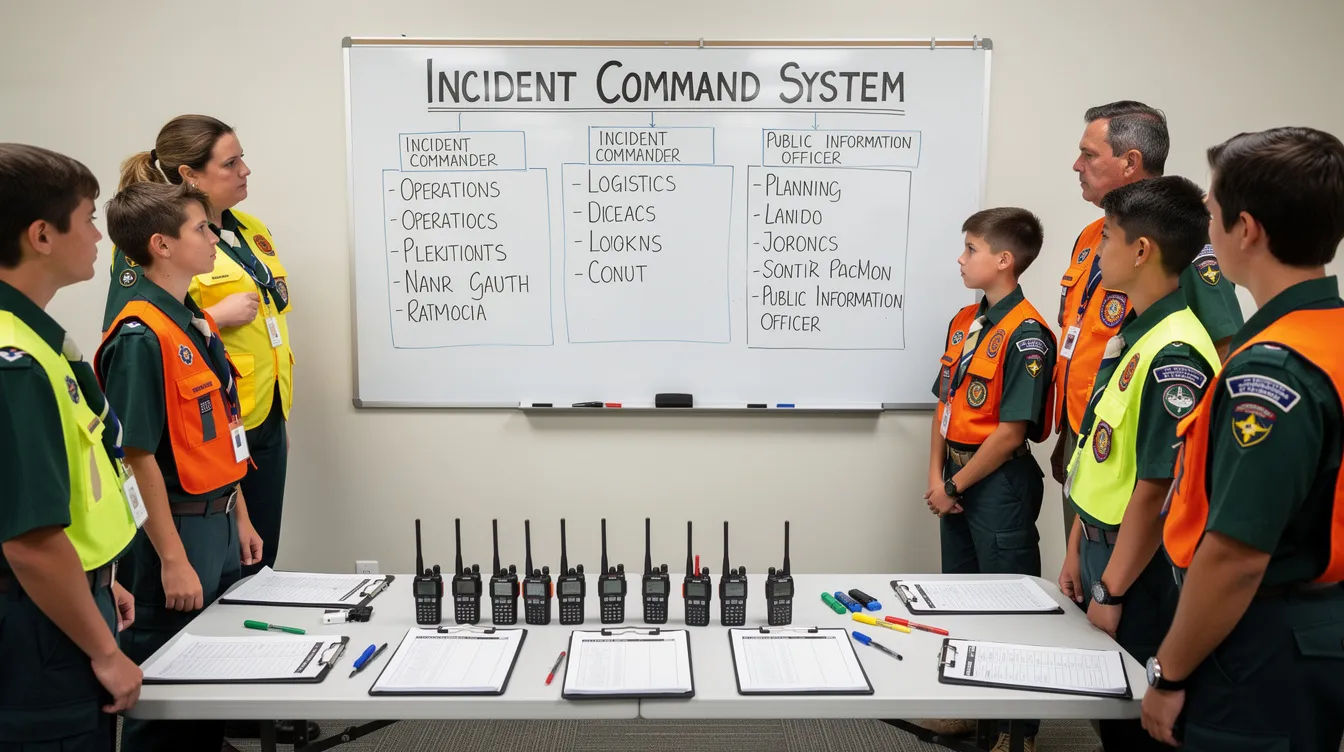
An ICS organizational chart brings structure to a community storm response drill.
Emergency Service, Mobilization Plans, and Community Projects
The merit badge requires Scouts to participate in an emergency service project or practice exercise under adult supervision and ICS-style organization. This can be a real event or a drill organized with a community agency, school, or Scout camp.
Emergency services include crowd and traffic control, as well as traffic control messenger service during large-scale events. Emergency services provide messenger services during incidents, assist with collection and distribution services, and offer group feeding, shelter, and sanitation support. These are real duties a Scout troop might be asked to perform-distribution services group feeding and shelter operations are common at disaster drill sites.
A mobilization plan is a written plan outlining step-by-step how a troop or patrol will respond when called. It should include:
- Alert procedures (phone tree, group text)
- Staging area address and directions
- Equipment each Scout should bring (personal emergency service pack)
- Role assignments matching ICS positions
- Demobilization and checkout procedure
Scouts in urban or small-space settings might support apartment complexes, schools, or local shelters during drills by organizing stairwell checks, distributing flyers, or assisting registration tables. Patrols should create compact, realistic mobilization plans focusing on roles youth can safely perform-information runners, supply runners, simple setup and teardown-and have them approved by your counselor.
Safety briefings, buddy systems, and clear communication are non-negotiable during any emergency service work. Adults must oversee and coordinate through ICS at all times.
About 25% of U.S. households reported at least one power outage in the past year, with 70% of those outages lasting six hours or more. That statistic alone justifies why every Scout troop should have a mobilization plan work ready before disaster strikes.
Photo 9: Scouts Providing Emergency Service at a Shelter
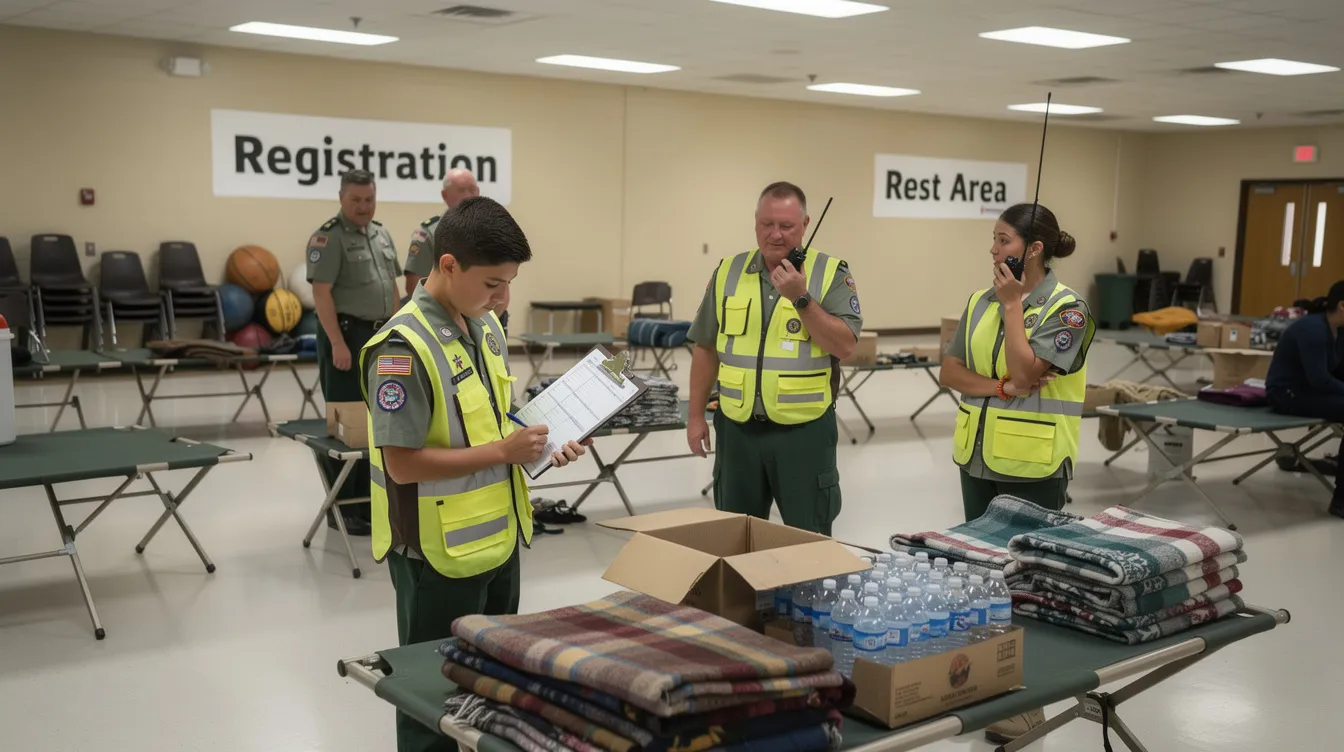
Scouts in action during a shelter drill, practicing real distribution and communication roles.
Careers in Emergency Preparedness and How This Badge Helps
A requirement asks Scouts to explore careers related to emergency preparedness. Options include interviewing an emergency services coordinator at a local city office, researching three career paths, or connecting badge skills to a personal hobby or healthy lifestyle.
Emergency services careers include roles in disaster management such as:
- Emergency manager or homeland security specialist
- Firefighter or paramedic
- Red Cross coordinator or relief logistics specialist
- Public health emergency planner
- Civil servant in a city or county emergency operations center
- Hospital continuity of operations planner
Emergency services coordinators manage disaster response efforts at the local and regional level. A Scout can interview one in person or by video call with questions prepared in advance. Suggest asking specifically about emergency plans for high-rise buildings, transit hubs, and large events.
Some of these careers can be performed remotely or from small home offices-continuity planning, hazard analysis, and training development are increasingly digital. The following emergency services roles are growing as climate resilience and grid vulnerability become national priorities.
Scouts can also connect their emergency preparedness skills to outdoor hobbies like backpacking, sailing, or mountain biking, showing how prevention and response planning supports a healthy lifestyle. Emergency preparedness listed among Eagle-required badges reflects how seriously Scouting America takes these skills.
Photo 10: Interview with an Emergency Services Professional
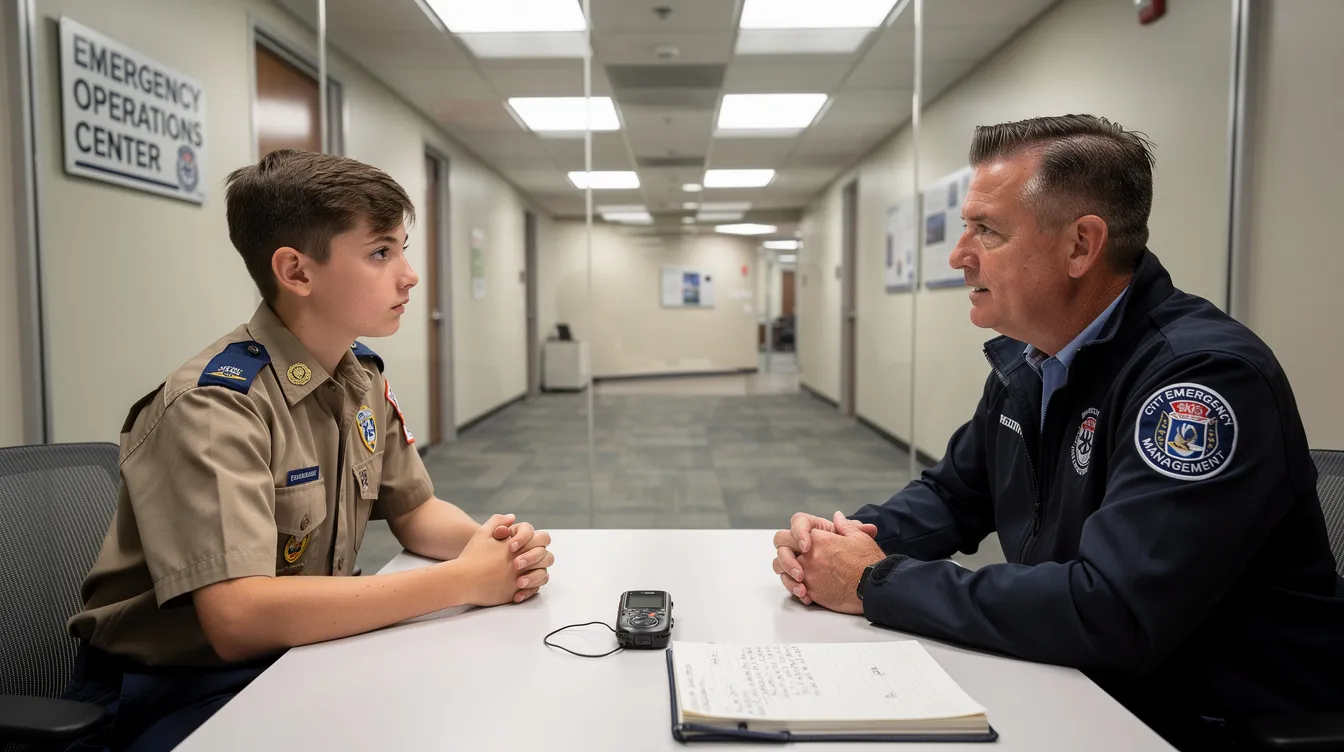
A Scout interviews a local emergency management professional about career paths and ICS roles.
How Small Space Emergency Supports Your Merit Badge Journey
Small Space Emergency is a resource focused on emergency preparedness for small homes, apartments, dorms, and tiny offices-the exact environments where many of today's Scouts and families live. While this article helps interpret requirements, Scouts must always follow the official BSA pamphlet or one approved by your counselor and complete all sign-offs through their troop or merit badge counselor.
Ways Small Space Emergency complements badge work:
- Compact emergency kit checklists sized for closets and under-bed storage
- Small-space storage ideas that turn emergency supplies into organized, accessible systems
- Printable family emergency cards for cabinet doors, wallets, and backpacks
- Apartment-friendly mobilization plan templates that fit urban troop operations
Use the merit badge as a deadline to finally assemble and organize your household go-kits, even in tight quarters. Practice evacuation or shelter-in-place drills a few times per year. Rotate emergency supplies on a calendar schedule.
Being prepared-no matter how small your space-is one of the most powerful ways to protect the people you care about and to be ready to serve your community. The skills from this badge do not expire when the blue card is signed.
Frequently Asked Questions
These questions address common concerns that go beyond the core requirements, focusing on timing, small-space challenges, and working with counselors.
How long does it usually take to earn the Emergency Preparedness merit badge?
Highly motivated Scouts who already hold First Aid can often complete Emergency Preparedness in three to six weeks, assuming they schedule a family meeting, home safety inspection, and an emergency service activity promptly. In many troops, the badge is spread over one to three months to allow time for drills, counselor meetings, and coordination with community events or service projects. Confirm your counselor's expectations for timelines and any required group sessions in advance-some counselors batch certain requirements into a single Saturday event.
What if I live in a dorm, rental, or shared apartment and cannot make big changes for safety?
Scouts and families in rentals can meet every requirement by focusing on portable solutions: door-hanging go-bags, under-bed storage kits, and printed plans that do not require altering the property. Talk with roommates and landlords about where fire extinguisher access points, alarm panels, and exits are located. Add door signs or posted emergency contact lists that can be removed when you move out. BSA requirements focus on planning, knowledge, and reasonable actions within your control-not on owning a house or making permanent building modifications.
Can I use digital tools instead of paper for my emergency plans and checklists?
Many counselors will accept digital documents, maps, and checklists as long as Scouts can show their work clearly during meetings on a tablet, laptop, or printed copies. Always keep at least one printed copy of family emergency plans and key phone numbers in case of power or network outages. Use cloud storage with offline access settings so important documents remain available on a phone or tablet during disasters.
Do I need special permission to participate in emergency service activities?
All Scout emergency service work must be organized or approved by adult leaders and, when applicable, by the community agency hosting the event or drill. Youth should never self-deploy to real disaster zones. Instead, take part through troop-organized projects, community drills, or training exercises at a Scout camp or school. Always follow local rules, ICS chains of command, and your counselor's or Scoutmaster's guidance when signing off requirement completions.
How often should we review our family emergency plans and kits once the badge is done?
Review and update family emergency plans at least once a year, or any time someone moves, changes schools, or changes phone numbers. Rotate food, water, batteries, and medications in emergency kits every six to twelve months, using calendar reminders or seasonal changeovers as prompts. Encourage Scouts to lead a brief drill or completed checklist review with their family twice per year, turning one-time badge work into an ongoing safety habit.
Editorial note: this guide provides general preparedness information, not emergency, medical, legal, or engineering advice. Recommendations are cross-checked against public emergency-management guidance and adapted for small-space living. During an active emergency, follow your local authorities and emergency services. See our editorial standards and affiliate disclosure.