Life-Saving Appliances: From SOLAS Rules to Real-World Survival
Every year, emergency situations on water claim thousands of lives. The difference between tragedy and survival often comes down to one thing: having the right gear within arm's reach. Life-saving appliances-the regulated safety systems carried on every commercial vessel on the planet-represent decades of hard-won engineering and global cooperation aimed at one goal: keeping people alive when things go wrong.
This guide breaks down the 10 essential types of life saving appliances you need to know, explains the international rules behind them, and shows you how to adapt those same proven principles to your apartment, small office, or compact living space.
Key Takeaways
- Life-saving appliances (LSAs) are specialized equipment mandated in the maritime industry to protect human life during emergencies. They include life jackets, immersion suits, survival craft, rescue boats, visual distress signals, and launching and embarkation appliances-all rigorously tested and standardized.
- The International Life-Saving Appliance (LSA) Code was adopted by the IMO in June 1996 and entered into force on 1 July 1998. It works alongside SOLAS Chapter III to define every life saving appliance required at sea, from personal flotation to lifeboat launch mechanisms.
- Core maritime concepts translate directly into compact, practical emergency gear for apartments and small offices. A certified life jacket on a closet hook, a grab bag by the front door, and a printed evacuation plan cost little but follow the same reliability principles used on ocean-going ships.
- Inspection, maintenance, and correct storage matter as much as owning the gear. SOLAS requires weekly visual checks of survival craft on ships; at home, a simple monthly walkthrough of your safety equipment keeps everything ready when seconds count.
- Throughout this article, you will find 10+ high-quality, photorealistic, HDR-style photographs showing real life jackets, immersion suits, rescue boats, liferafts, and small-space emergency setups in a consistent, polished listicle format designed to make every item instantly recognizable.
Regulatory Background: How the LSA Code Defines Life-Saving Appliances
Modern life saving appliances are standardized worldwide by the International Maritime Organization (IMO) through two interlocking frameworks: the SOLAS Convention and the LSA Code. Together, they guarantee that every piece of survival equipment on a ship-from a whistle on a life jacket to the davit crane lowering a lifeboat-meets specific technical requirements for design, build, and performance. Even if you never set foot on a commercial vessel, understanding this regulatory backbone helps you evaluate the quality of any emergency gear you bring into your home.
The International Life-Saving Appliance Code was adopted by the IMO Maritime Safety Committee (MSC) in June 1996 via IMO Resolution MSC.48(66) and became mandatory on 1 July 1998 under SOLAS regulation III/3.10. In practical terms, the LSA Code converts the broad safety mandates in SOLAS Chapter III into testable, enforceable standards-covering everything from buoyancy ratings on lifejackets to burn times on parachute flares. Regulations require that life-saving appliances must be readily available and operational during emergencies; they cannot simply exist on paper.
Consolidated amendments to the LSA Code entered into force on 1 July 2010, updating materials, testing criteria, and construction specs across many categories. Ongoing updates continue to refine the rules: recent amendments under resolutions MSC.482(103) and MSC.485(103), effective January 2024, tighten requirements for launch and release gear. The code is living regulation, adopted and re-adopted as technology and incident data evolve.
The LSA Code categorizes life-saving appliances into five types:
- Personal protection - life jackets (inherently buoyant and inflatable), immersion suits, anti-exposure suits, and thermal protective aids
- Visual signals - hand flares, parachute flares, buoyant smoke signals, and signal lights
- Survival craft - lifeboats (open, partially enclosed, totally enclosed) and inflatable liferafts
- Rescue boats - smaller craft designed to recover persons from the water and organize liferaft groups
- Launching and embarkation appliances - davits, embarkation ladders, marine evacuation systems, and release mechanisms
A note from Small Space Emergency: While the SOLAS convention applies to ships, the underlying principles-redundancy, reliability, compactness, and tested performance-are exactly what should guide your apartment or small-office emergency planning. You don't need a davit crane, but you do need gear that works under stress, stored where you can reach it fast.
Core Types of Life-Saving Appliances (With Visual Examples)
This section is a visually driven listicle. Each item pairs a photorealistic, HDR-style photograph with concrete technical details, SOLAS requirements, and practical tips for adapting maritime-grade safety thinking to compact living. The images maintain a consistent style-sharp detail, natural lighting, professional composition-so you can see exactly what these appliances look like in the real world.
1. SOLAS Life Jacket Close-Up
A SOLAS-approved life jacket is engineered for one scenario: keeping an unconscious person alive in open water. Life jackets must turn an unconscious wearer face-up within 5 seconds-a requirement that separates them from casual buoyancy aids you might grab at a lake rental shop.
Key features include a minimum buoyancy rating of 150 newtons (roughly 15 kg of lift), retro-reflective tape visible from rescue helicopters and ships, an integrated whistle, a compact waterproof light, and crotch or leg straps that prevent the jacket from riding up over the wearer's head. Ships must carry a life jacket for every person on board, plus additional spares for watch stations and among others on the embarkation deck.
For apartment dwellers, a single certified life jacket per household member-hung on a closet-door hook near the exit-provides immediate protection during flash floods or coastal storm surges.
2. Personal Life Saving Appliances Array
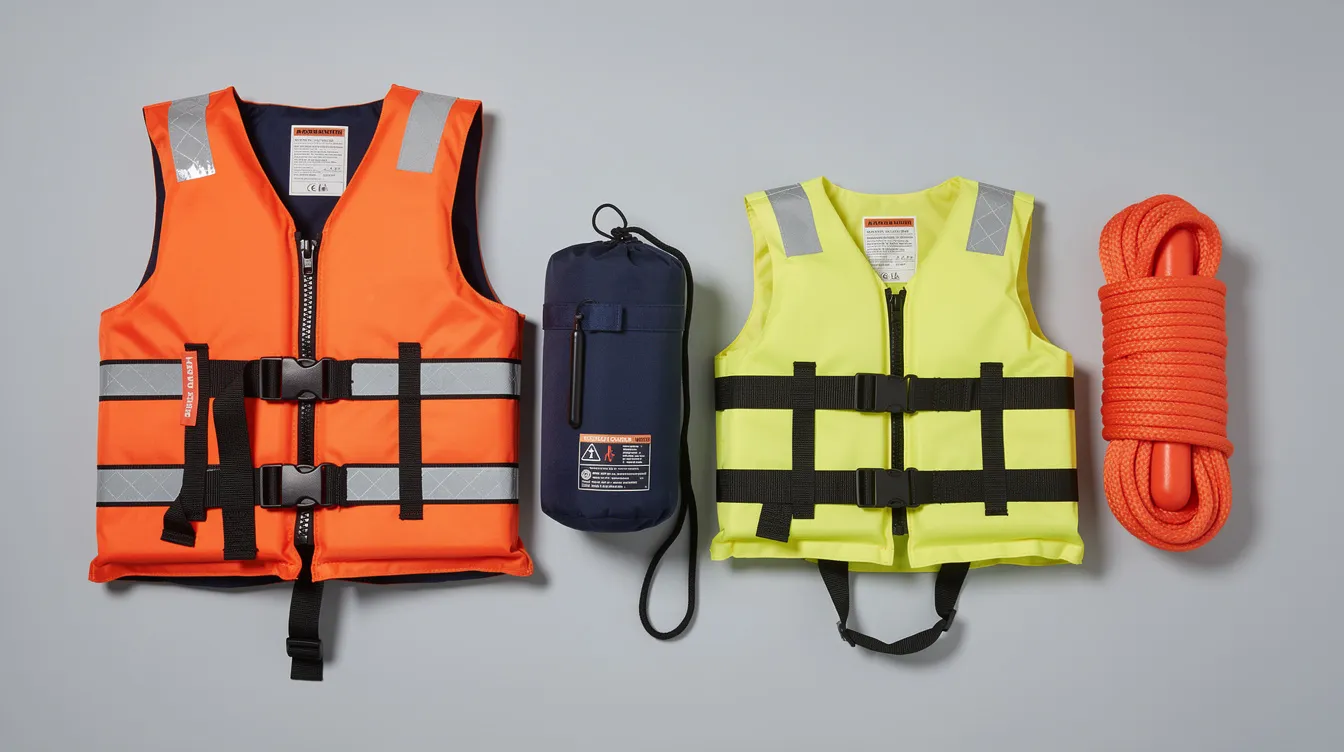
Personal life saving appliances cover a range of gear designed to keep individuals afloat or protected from exposure. This category spans standard inherently buoyant foam lifejackets rated at 100 N, compact inflatable PFDs that pack down to the size of a fanny pack, child-size vests with grab handles, and throw lines for reaching someone in the water from shore or deck.
Buoyancy levels under ISO 12402 are standardized across tiers: 50 N for sheltered-water buoyancy aids, 100 N for inshore jackets, 150 N for offshore and SOLAS compliance, and 275 N for extreme offshore use in heavy clothing. Understanding these numbers helps you pick the right level for your situation.
Storage in a small apartment is straightforward: flat wall hooks handle foam jackets, while deflated inflatable PFDs fit inside a drawer or slim bin. A throw line coils into a bag the size of a softball. The goal is to meet international requirements for personal safety without surrendering closet space.
3. Immersion Suits on a Rack
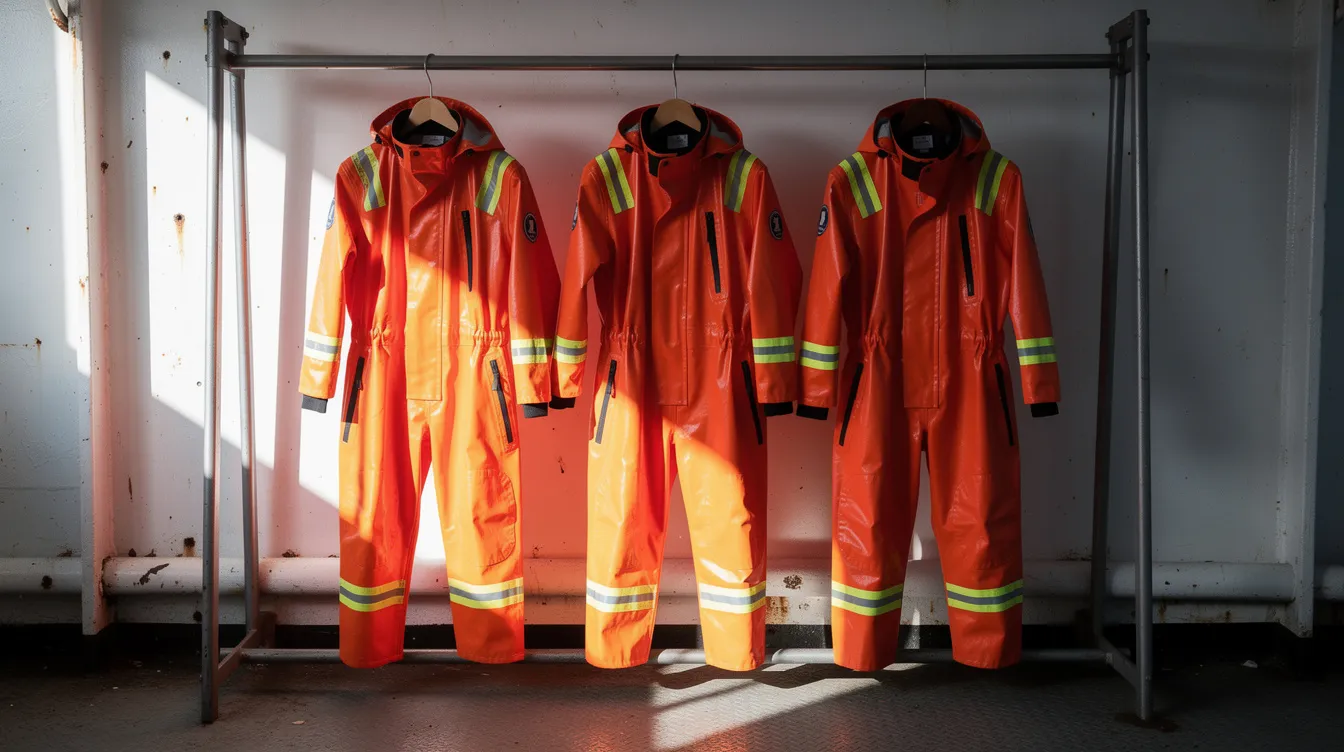
Immersion suits are full-body survival garments that seal at the wrists, ankles, and neck to create a near-watertight barrier between the wearer and cold water. Their primary mission: immersion suits slow down the onset of hypothermia in cold waters, buying critical hours for rescue. Some performance standards require that the wearer's core body temperature does not drop more than 2°C after six hours of immersion in water between 0°C and 2°C.
Under SOLAS and the saving appliance LSA Code, immersion suits must be inspected monthly-checking seams, closures, zippers, retro-reflective materials, lights, and whistles. Every three years, suits undergo more rigorous testing: air-pressure checks on seams and closures to confirm waterproof integrity, in accordance with MSC/Circ.1114 guidelines. Suits over ten years old require annual testing.
For private owners-particularly offshore sailors, small fishing boat operators, or residents of extreme cold coastal regions-immersion suits are a serious investment in both cost and storage. They hang well on heavy-duty coat hooks behind a door, but their bulk means they're best suited for people with a genuine cold-water risk profile.
4. Lifebuoy and Throw Line
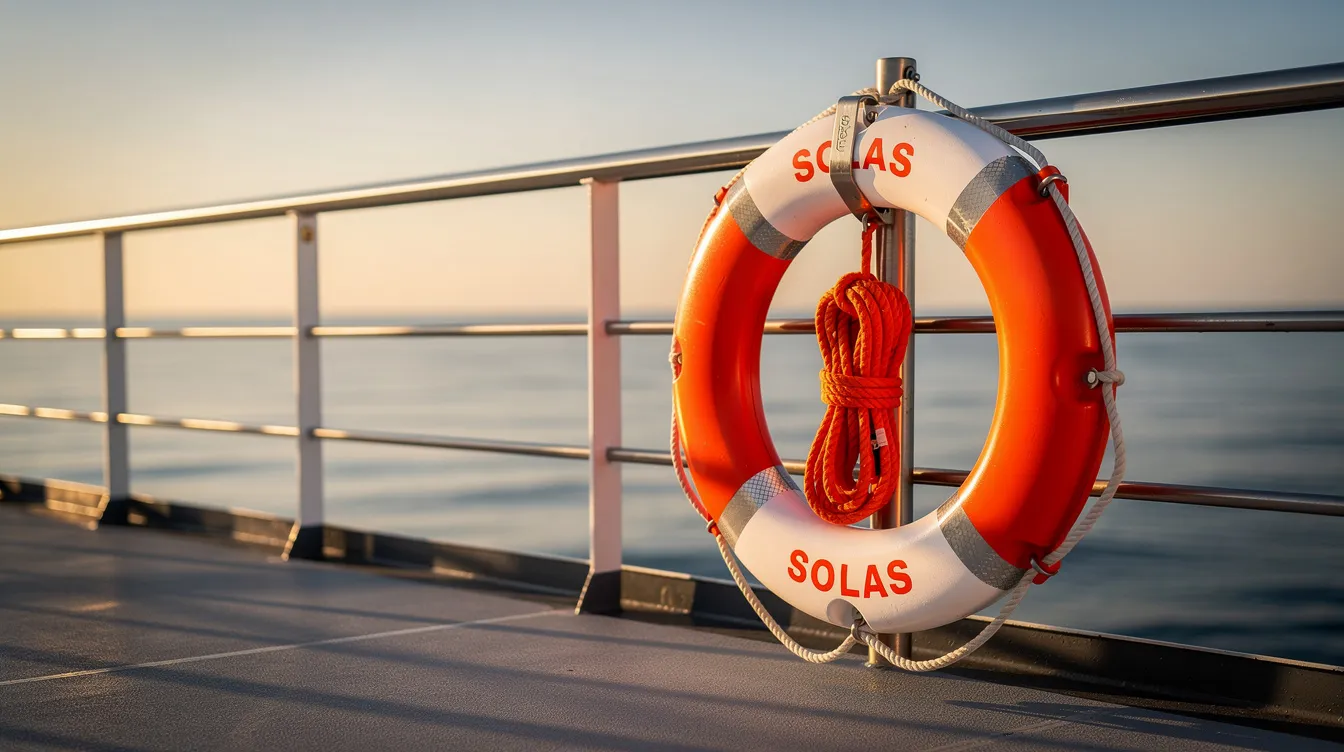
Lifebuoys are ring-shaped devices thrown to a person in distress to help them stay afloat. They are among the simplest and most recognizable pieces of survival equipment in the world. A standard SOLAS lifebuoy includes retro-reflective tape for visibility, a buoyant heaving line (often 30 meters), and in many cases an attached self-igniting light and buoyant smoke signal for nighttime recovery.
Ships carry lifebuoys in specific numbers-distributed along both sides of the vessel-with at least some fitted with self-activating lights and at least one with a buoyant smoke signal. The arrangement ensures that no matter where someone goes overboard, a lifebuoy is within throwing distance.
For riverside marinas, lakeside homes, or even apartment complexes with rooftop pools, a mounted ring buoy with a throw line is inexpensive, takes up minimal wall space, and provides an immediate rescue option for man-overboard situations that happen far more often than most people assume.
5. Survival Craft: Enclosed Lifeboat
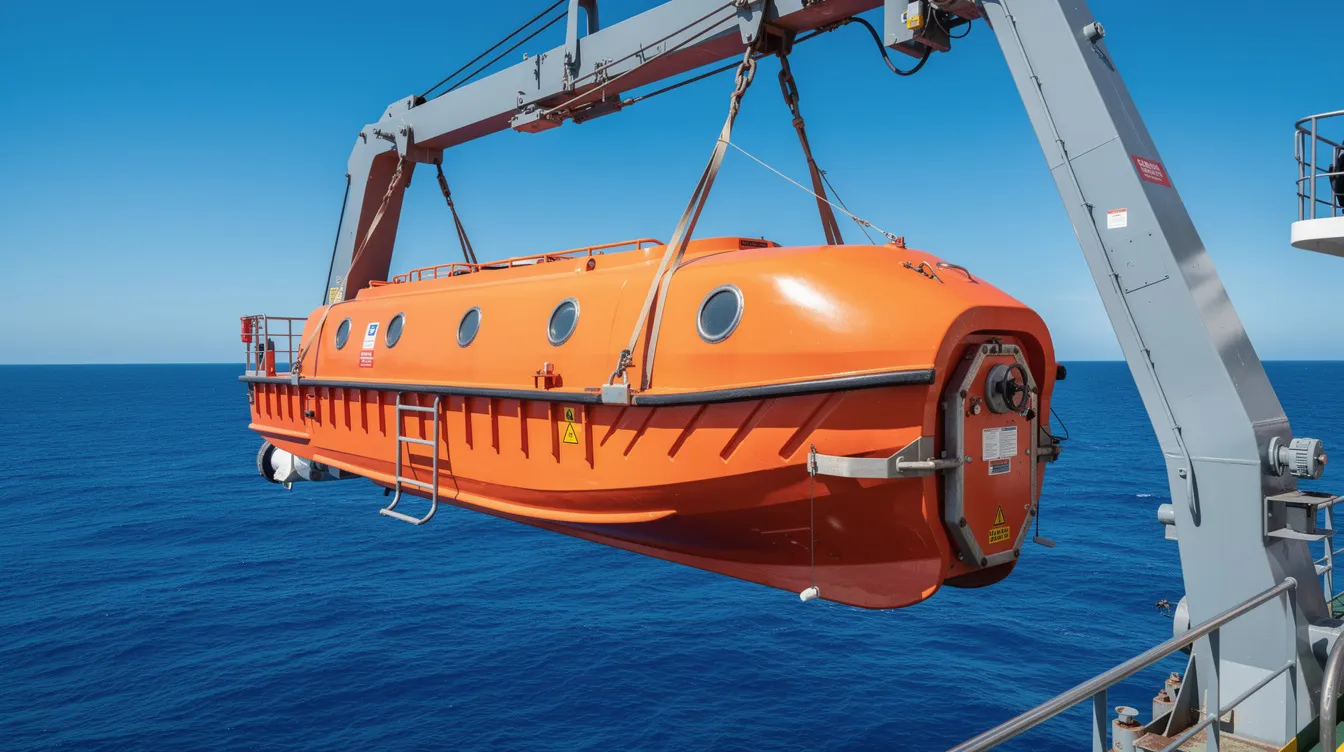
Survival craft is the umbrella term for lifeboats and liferafts-vessels designed to carry people away from a sinking or burning ship and keep them alive until rescue arrives. Life saving appliances differ significantly within this category: totally enclosed lifeboats protect occupants from weather, fire, and rough seas, and many are self-righting if capsized. Partially enclosed or open lifeboats are lighter and cheaper but offer less protection.
SOLAS mandates survival craft capacity for every person on board. The launching appliances that lower these boats must function reliably in fog, icing, darkness, and heavy seas. Every lifeboat has specific requirements for freeboard, boarding arrangements, engine starting capability, and onboard supplies including water, rations, visual aids, and first-aid materials.
While most apartment dwellers won't store a lifeboat, understanding survival craft reinforces a core principle: your emergency plan should include a way to get out, not just gear to survive in place.
6. Inflatable Liferaft Canister on Deck
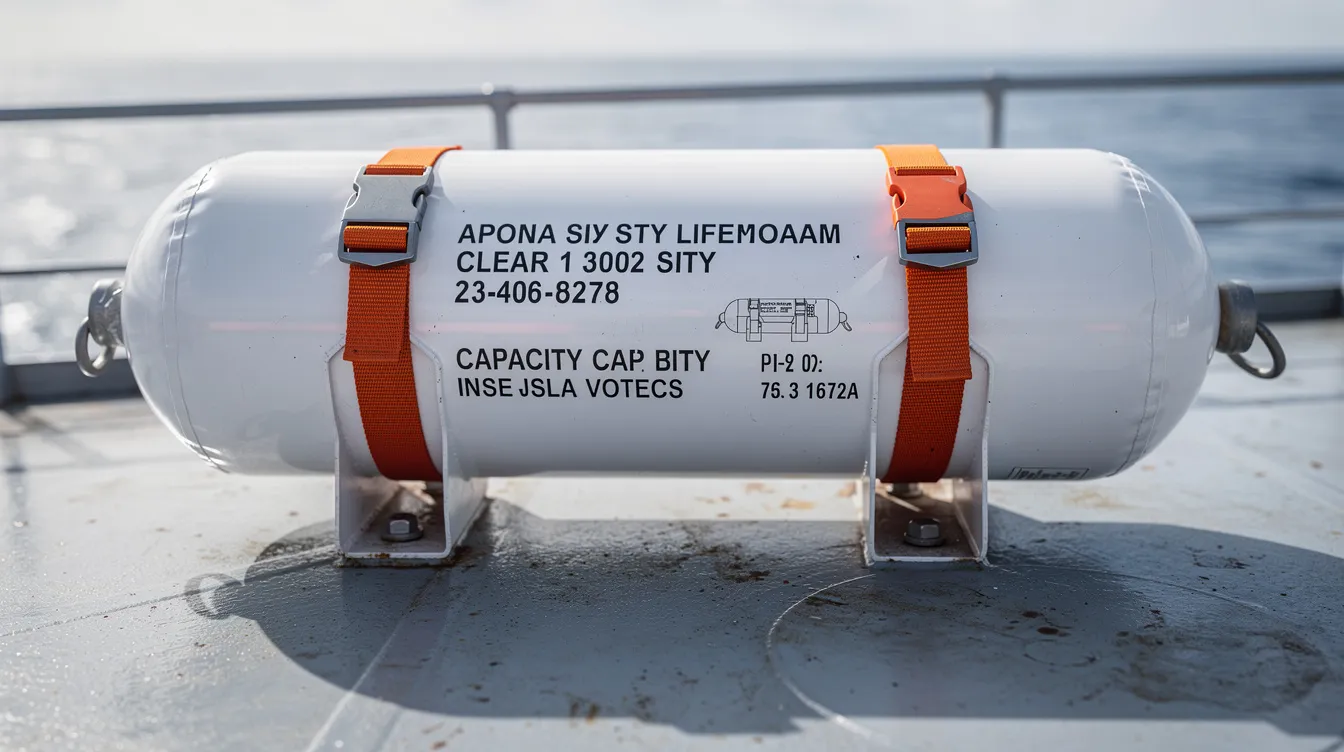
Liferafts are inflatable or rigid craft providing shelter and protection during emergencies at sea. Most modern liferafts are stored in fiberglass canisters on deck and deploy via either manual release or a hydrostatic release unit that triggers automatically if the ship sinks beyond a certain depth-a critical redundancy feature for scenarios where the crew cannot manually launch.
Inflatable liferafts must be serviced every 12 months at approved stations, where technicians inspect fabric integrity, inflation systems, emergency supplies, and canopy structures. Under specific controlled packing conditions, some flag states allow extended servicing intervals of up to 30 months via IMO circulars. But the default is annual-no exceptions for negligence.
For small-boat owners or coastal residents, compact valise-style liferafts exist that stow in a locker or under a berth. They're expensive and require that same annual servicing commitment, but for anyone conducting operations on open water, they're non-negotiable.
7. Rescue Boat in the Water
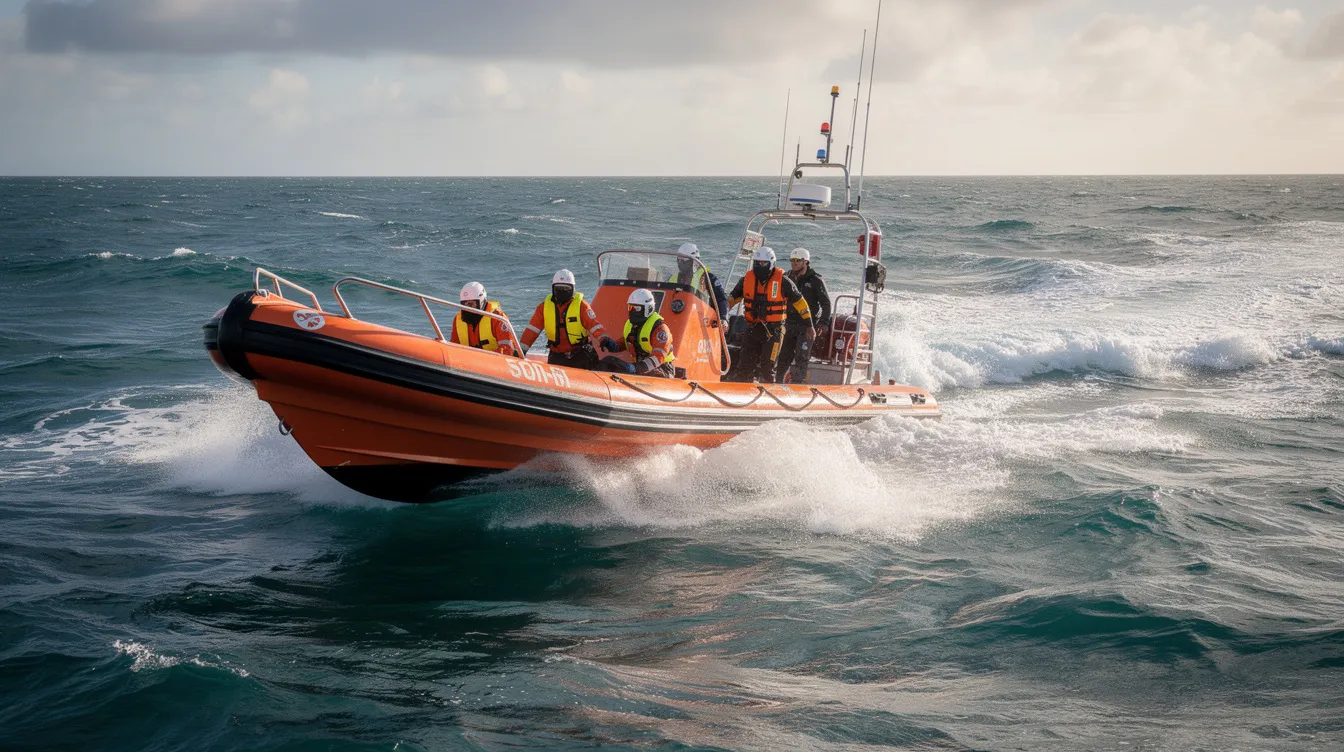
Rescue boats are smaller, faster craft carried on ships to recover persons from the water and assist in organizing liferaft groups after an abandon-ship order. Rescue boats must recover a person from the water at 6 knots-fast enough to reach a casualty before hypothermia or exhaustion sets in. SOLAS mandates at least one rescue boat on cargo ships, and passengers vessels typically carry more.
These boats differ from lifeboats in purpose: a lifeboat is for mass evacuation, while a rescue boat-including fast rescue boats used on offshore installations-is for targeted, rapid man-overboard response. Crew members operating rescue boats train regularly in launch, recovery, and casualty handling procedures.
The principle translates to smaller-scale planning: in any emergency, someone needs the ability to go toward the danger, not just away from it. For community marinas and waterfront buildings, having a designated rescue craft and trained volunteers can save lives in the critical minutes before coast guard or emergency services arrive.
8. Launching and Embarkation Appliances
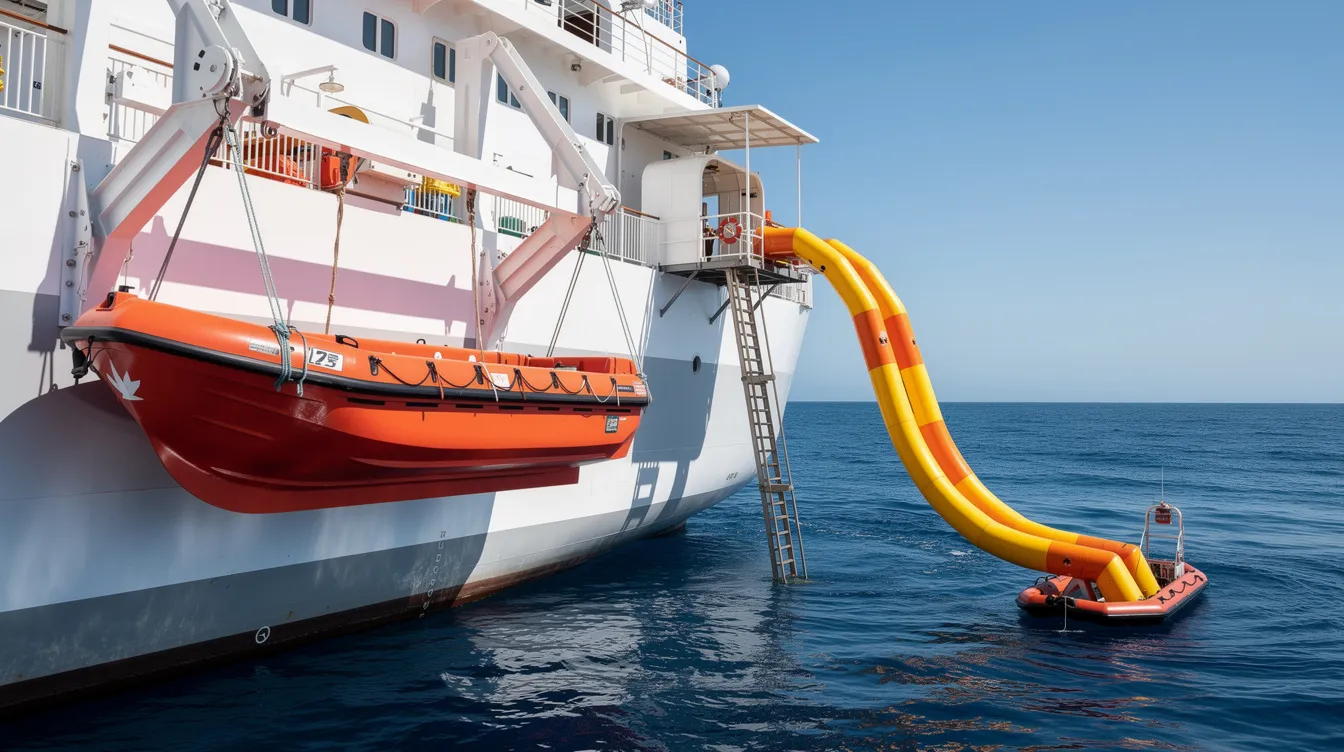
Launching and embarkation appliances are the mechanical systems that move people safely from a ship to survival craft. This category includes gravity davits (which swing lifeboats outboard and lower them by gravity), mechanical winch davits, embarkation ladders for climbing down to water-level craft, and Marine Evacuation Systems (MES). Marine Evacuation Systems allow rapid evacuation from high decks into liferafts without traditional lowering methods-essentially large inflatable slides that connect the embarkation deck directly to a floating liferaft, enabling hundreds of passengers to evacuate in minutes.
These systems undergo annual operational tests and five-year thorough structural examinations. On-load release mechanisms-the hooks that hold a lifeboat during lowering-are among the most safety-critical components on any ship, and their failure has caused fatalities in the past. The manufacture and testing of every component must comply with specific technical requirements laid out in the LSA Code.
For non-mariners, the takeaway is about accessibility: your emergency exit route should be clear, practiced, and mechanically sound. A fire escape ladder stored in a bedroom window frame is, in principle, the apartment equivalent of a davit-a launching system that gets you from a high stage to safety below.
9. Visual Distress Signals
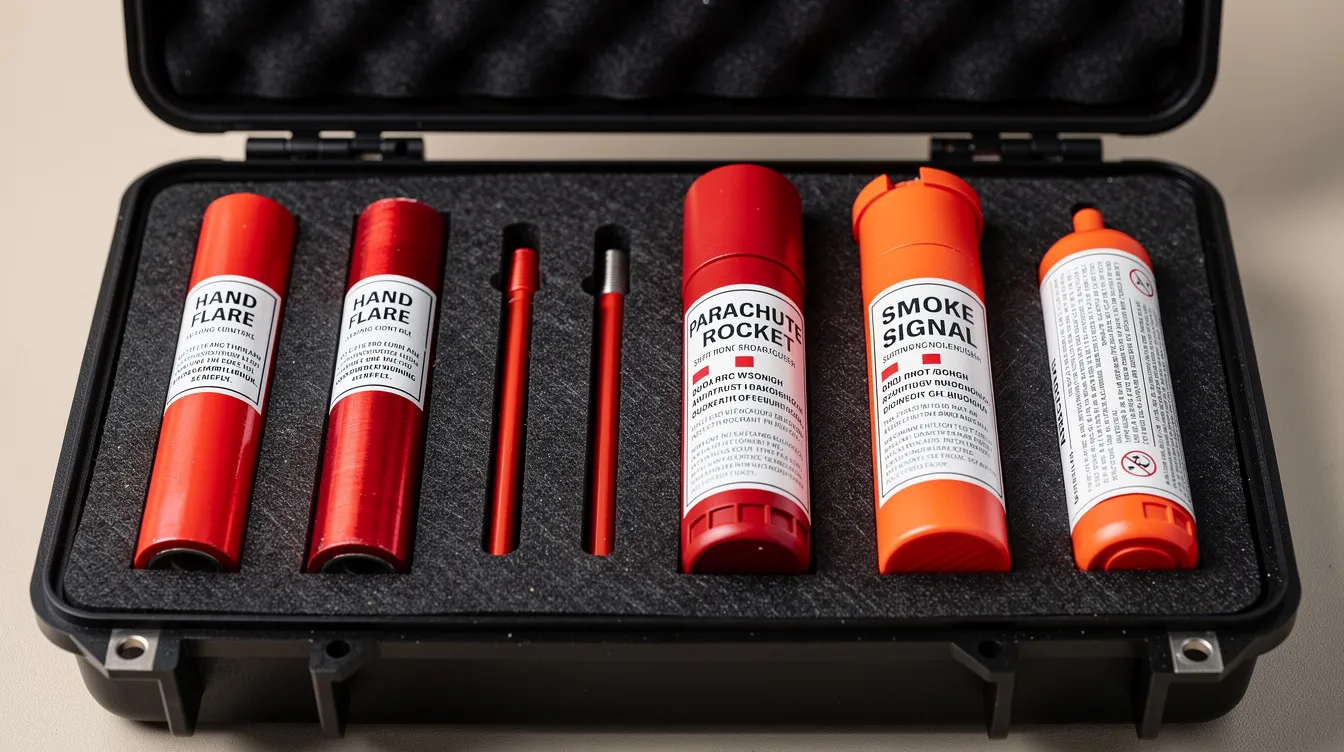
Visual signaling appliances include flares and smoke signals-pyrotechnic and non-pyrotechnic devices designed to attract attention over long distances. Under the LSA Code, SOLAS requires parachute flares to burn for at least 40 seconds at high luminous intensity, visible at night from roughly 10 to 12 kilometers. Hand flares burn for approximately 45 seconds and are primarily useful at shorter ranges. Buoyant smoke signals produce dense orange smoke for about 60 seconds, serving as daytime visual aids when flares would be hard to see against sunlight.
These visual signals complement electronic alerting devices like EPIRBs. EPIRBs are satellite transmitters that broadcast distress signals and GPS coordinates for rescue operations-they tell rescuers where you are, while flares tell them exactly which speck on the water to aim for.
A growing trend, particularly noted in UK Maritime Information Notice MIN 542 Amendment 3, is the shift toward non-pyrotechnic electronic visual distress signals (EVDS)-LED-based devices with battery lives of 20+ hours that eliminate the storage, handling, and disposal challenges of traditional flares.
For small-space emergency planning, compact LED signal lights and personal locator beacons are far more practical than pyrotechnic flares. They require no special storage, carry no fire risk, and many models meet or exceed the visibility performance of traditional signals. Add a general alarm device-even a loud personal alarm-to your kit for attracting attention in smoke, darkness, or flooding.
10. Small-Space Emergency Corner (Apartment)
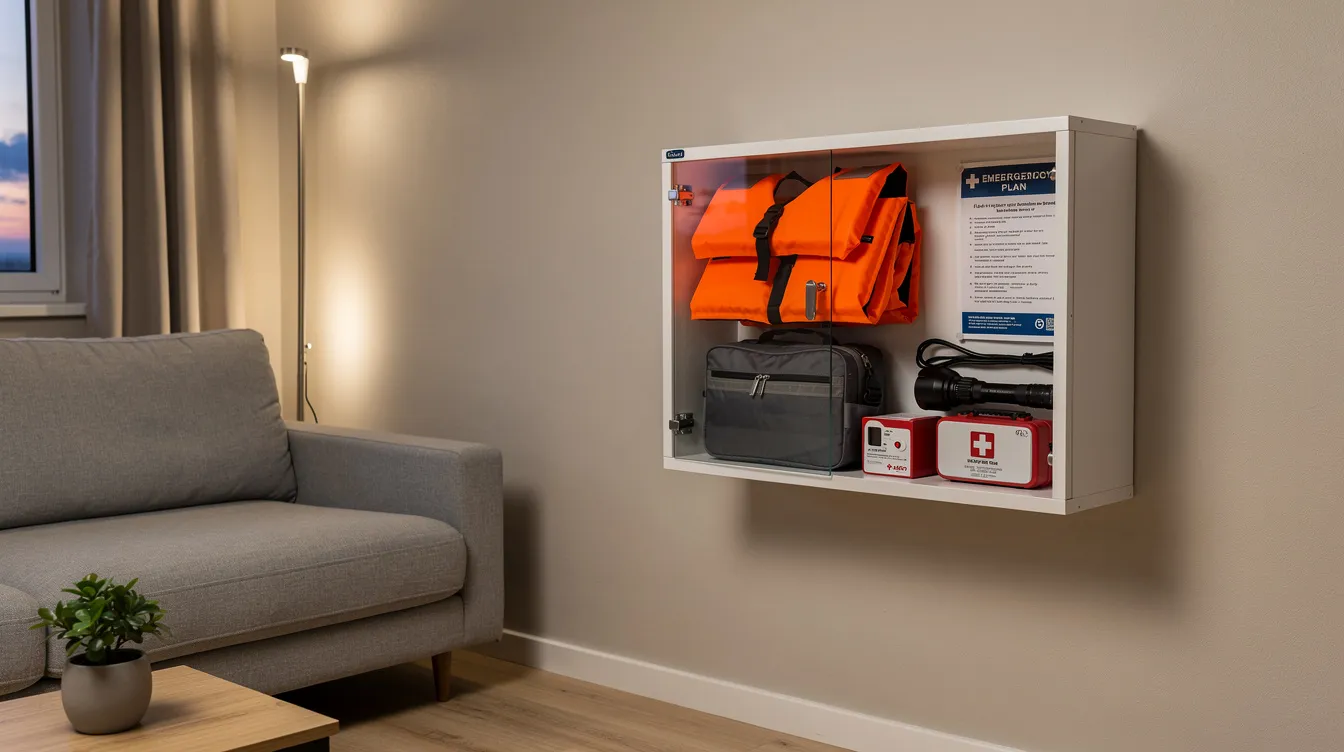
This is where maritime safety meets your daily life. The principles behind every life saving appliance on a ship-tested performance, accessibility, redundancy, and regular maintenance-apply directly to emergency preparedness in apartments, studios, and small offices.
A well-designed emergency corner includes:
- One certified life jacket per person - foam or inflatable, stored where you can grab it in under 30 seconds
- A compact grab-and-go bag - containing a flashlight with fresh batteries, a whistle, light sticks, a signal mirror, a compact first-aid kit, a thermal blanket, and a printed emergency plan with contact numbers
- Signaling capability - an LED personal locator light or electronic distress signal, replacing bulky pyrotechnic flares
- Public address systems equivalent - a charged phone with emergency apps, a battery-powered weather radio, and a loud personal alarm to signal for help or alert neighbors
This setup occupies less than two square feet of wall space. It respects your home's aesthetic while ensuring you can protect yourself and your family during coastal storms, flash floods, or building evacuations. The page you're reading now exists because life-saving appliances enhance survival chances by providing protection against drowning and adverse weather conditions-and that protection shouldn't be limited to people at sea.
11. Compact "Go Bag" with Maritime-Inspired Gear
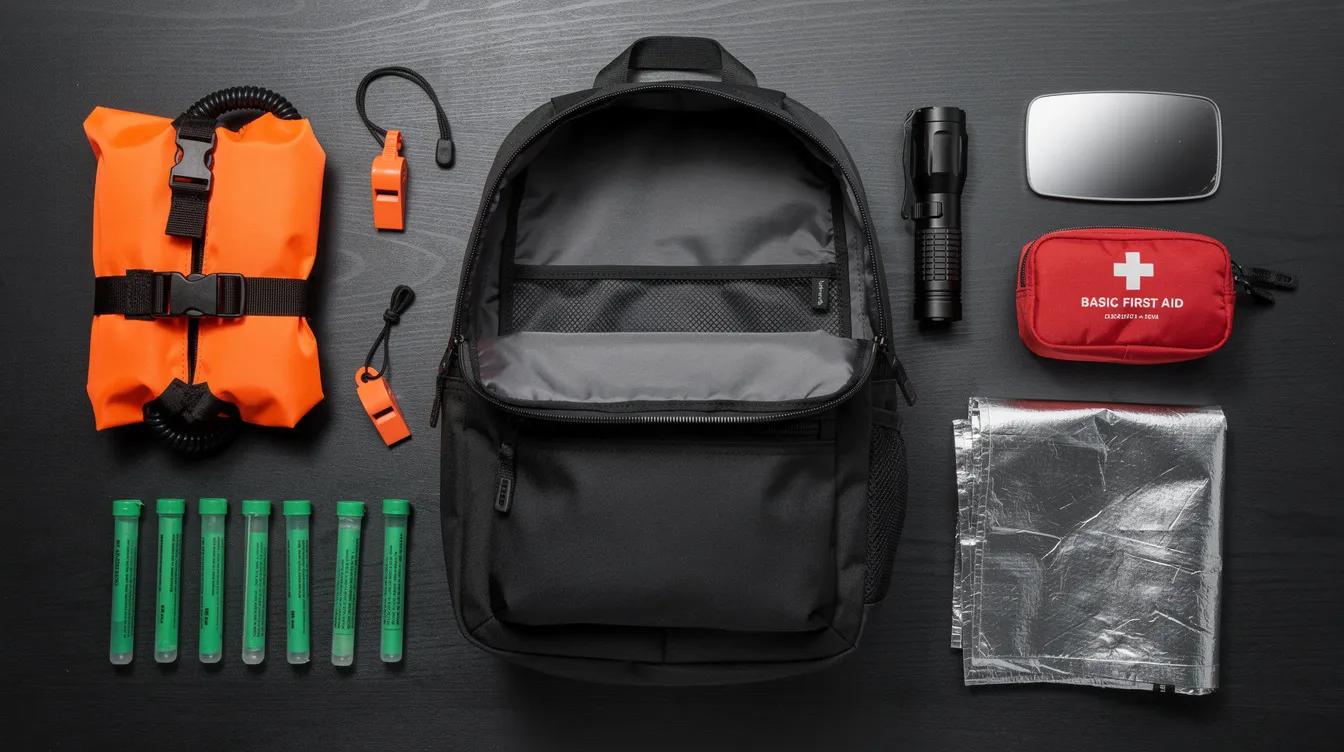
For people living near coasts, rivers, or flood zones, a compact go bag inspired by maritime survival equipment is one of the highest-impact preparations you can make. The concept borrows directly from the abandon-ship bag carried by professional mariners: pre-packed, lightweight, and containing only what keeps you alive for the first 24 to 72 hours.
A maritime-inspired go bag should include:
- A compact manual-inflate life jacket (many weigh under 300 grams and meet ISO 150 N standards)
- An emergency whistle rated to 100+ decibels
- Chemical or LED light sticks for visibility
- A signal mirror for daytime signaling to aircraft or distant boats
- A basic first-aid kit focused on wound care and water purification
- A thermal protective blanket (the emergency survival equivalent of thermal protective aids used on ships)
- Waterproof copies of identification and emergency contacts
Total weight: typically under 2 kg. Total footprint: fits in a daypack that slides under a bed or hangs on a door hook. Training to use each item takes less than an hour-and that hour could define the difference between a close call and a catastrophe.
Inspection, Maintenance, and Small-Space Adaptation of Life-Saving Appliances
Life saving appliances only deliver their promise if they work the moment you need them. On ships, LSAs are inspected and maintained regularly according to established regulatory standards enforced through port state control and flag state inspections. The same discipline-scaled down and simplified-should govern how you manage safety gear in your home, apartment, or small office.
Here is how shipboard routines translate into household practice:
- Weekly on ships → Monthly at home. SOLAS requires weekly visual checks of survival craft, rescue boats, and launching gear. Ships also test general alarm and public address systems weekly. At home, a once-a-month walkthrough takes five minutes: confirm life jackets are on their hooks, check that flashlight batteries work, verify your grab bag hasn't been raided for band-aids, and test your weather radio.
- Monthly on ships → Quarterly at home. Ships inspect immersion suits and anti-exposure suits monthly-checking zippers, seals, lights, and whistles. For household gear, a quarterly hands-on check is reasonable: try on each life jacket, inspect straps for fraying, confirm inflation bladders (if applicable) hold air, and ensure lights and whistles are present and functional.
- Annual on ships → Annual at home. Liferafts must be serviced every 12 months at approved stations. EPIRBs, hydrostatic release units, and SCBA cylinders have fixed service intervals, and port state control inspects records. Your home equivalent: set annual calendar reminders to check expiry dates on flares, batteries, first-aid supplies, and any inflatable life jackets. Replace anything past the manufacturer's recommended life-typically around 10 years for most PFDs.
Compact inspection checklist for household life jackets and personal life saving appliances:
- Straps intact, no fraying or broken buckles
- No tears, punctures, or UV degradation in fabric
- Inflation bladders (if inflatable) hold air when manually inflated
- Whistle attached and functional
- Light unit present, battery not expired
- Retro-reflective tape in place and not peeling
- Record keeping: log the date and result of each check in a note app or printed sheet
Space-saving storage tips:
- Use the inside of closet doors for wall hooks to hang life jackets flat
- Store immersion suits or seasonal gear in slim under-bed bins or vacuum storage bags
- Place a slim vertical cabinet or wall-mounted waterproof box near your front door for grab bags, signaling devices, and flashlights
- Label every storage location clearly-in an emergency, anyone in your household should find gear without instructions
Accessibility matters. Place personal life saving appliances near the main exit, not buried behind heavy furniture or stacked in a back closet. If you live in a flood zone, gear on the ground floor should be at waist height or above-not on the floor where rising water reaches it first.
Borrow the "muster station" concept from ships. Every vessel designates a muster station where crew and passengers gather during emergencies. Designate one spot in your home-by the front door is ideal-where essential life saving items, your emergency kit, and your printed evacuation plan are always kept. Make sure every person in your household knows where it is and what's in it. Run a quick walkthrough at least once a year, the way ships conduct training drills with crew before every voyage.
At Small Space Emergency, we curate compact emergency kits and storage solutions built on the same reliability and redundancy principles as maritime life saving appliances-but optimized for tight urban living. Because compliance with good safety practice shouldn't require a cargo hold.
Frequently Asked Questions About Life-Saving Appliances
What are the main types of life-saving appliances under the LSA Code?
The LSA Code organizes life saving appliances into five main categories. Personal life saving appliances include life jackets (both inherently buoyant and inflatable), immersion suits, anti-exposure suits, and thermal protective aids. Survival craft include lifeboats and liferafts for emergencies-ranging from totally enclosed, self-righting lifeboats to compact inflatable liferafts stored in canisters. Rescue boats are smaller, high-speed craft used to recover people from the water. Visual distress signals cover hand flares, parachute flares, and buoyant smoke signals. Finally, launching and embarkation appliances encompass davits, marine evacuation systems, embarkation ladders, and release mechanisms. Together with many others-like line-throwing equipment, EPIRBs, and general alarm systems-these categories form the complete suite of safety provisions that every ship must carry in compliance with the SOLAS convention.
How do SOLAS life-saving appliance rules matter if I just live in an apartment?
SOLAS regulations apply to ships, not private homes. But the underlying philosophy-tested, certified, easy-to-deploy gear stored where anyone can reach it-is universally relevant. If you live in a flood-prone area, near a coast, or along a river, gear that meets SOLAS or equivalent standards (ISO, UL, USCG-approved) means it has been tested against failure under real-world stress. A 150 N life jacket provides meaningfully more protection than an untested inflatable pool toy. The principle of redundancy (having both flotation and signaling, not just one) and the emphasis on plans and drills carry over directly. You don't need to comply with maritime law, but you can build your home safety around the same hard-earned standards that protect human life at sea.
How often should I inspect or replace my life jackets at home?
Perform a quick visual check before each use: straps secure, no visible damage, whistle attached. Every 6 to 12 months, conduct a more detailed inspection-manually inflate inflatable models to confirm the bladder holds air, verify that the light unit and battery work, and check for UV damage or fabric degradation. Most manufacturers recommend replacing foam life jackets after about 10 years of use, though earlier replacement is warranted if you find compressed buoyancy foam, broken zippers, or significant fading. For inflatable jackets, follow the manufacturer's service schedule for CO2 cartridge and auto-inflation mechanism checks. Add reminders to your phone calendar-the same way a ship's crew tracks mandatory servicing intervals through rigorous record keeping.
Can immersion suits or survival craft be practical for private owners?
Immersion suits and liferafts are specialized, expensive, and require ongoing maintenance. That said, they make practical sense in specific scenarios: small fishing boat operators in cold-water regions, offshore sailors, or residents of remote coastal communities where rescue response times are long. Immersion suits range from around $200 to $800 and need proper storage (hung, not folded) and periodic inspection. Compact valise liferafts for 4 to 6 persons are available for small vessels but require annual servicing at approved stations. For most apartment dwellers, these items are overkill-but if your application involves regular time on open water in cold conditions, the sale price of an immersion suit is trivial compared to its capacity to save your life.
What's the difference between a life jacket and a personal flotation device (PFD)?
The term "life jacket" typically refers to devices meeting strict standards like SOLAS or ISO 150 N+, designed to automatically turn an unconscious wearer face-up in the water and provide high buoyancy with features like crotch straps, lights, whistles, and retro-reflective tape. A "personal flotation device" (PFD) is a broader category that includes recreational buoyancy aids offering lower buoyancy (50 N), greater freedom of movement, and a focus on comfort for activities like kayaking or paddle boarding-but these devices may not turn an unconscious person face-up. For readers of Small Space Emergency, the right choice depends on your risk profile: if you're near deep, cold, or fast-moving water, invest in a proper life jacket that meets or exceeds 150 N. For calm, supervised water activities, a recreational PFD may be sufficient-but know its limits and never assume it will perform like a SOLAS-grade life jacket.
Editorial note: this guide provides general preparedness information, not emergency, medical, legal, or engineering advice. Recommendations are cross-checked against public emergency-management guidance and adapted for small-space living. During an active emergency, follow your local authorities and emergency services. See our editorial standards and affiliate disclosure.